If you’re searching for how to register my dog in Galveston County, Texas, the most important thing to know is that “registration” is usually handled through a local dog license or rabies enforcement/animal services process—and it often depends on whether you live inside a city limit (like Galveston) or in an area served by county animal services.
This landing page explains how a dog license in Galveston County, Texas typically works, what rabies paperwork is required, and where to register a dog in Galveston County, Texas using examples of official offices that residents commonly contact for animal control, rabies control authority questions, quarantine release, and local ordinance enforcement.
Where to Register or License Your Dog in Galveston County, Texas
Because local rules vary by city and service area, the right place to get help with an animal control dog license Galveston County, Texas questions (or rabies enforcement, bite reporting, or quarantine release) can depend on where you live. The offices below are official government agencies commonly involved in rabies control authority functions, animal control response, and related “registration” steps within Galveston County.
Galveston County Health District (GCHD) — Animal Services / Animal Control
Galveston County Animal Resource Center (ARC) — Rabies/Bite Reporting & Quarantine-Related Contact
- Report animal bites for rabies control authority follow-up
- Ask about quarantine procedures and release requirements
- Ask whether “county registration” is required during release (when applicable)
City of Galveston — Animal Services Unit (City Marshal’s Office)
City of La Marque — Animal Control (City Information / Coordination)
City of League City — Animal Care
City of Texas City — Animal Control Dispatch (City-Run Dispatch)
How to choose the right office
- Check your address: Are you inside a city limit (Galveston, League City, Texas City, etc.) or in an unincorporated area?
- Call the city first if you’re inside a city that runs its own animal services or licensing/tag program.
- Call GCHD Animal Services / ARC if you’re in an unincorporated area or a participating jurisdiction served by county field animal control, or if you have a rabies/bite/quarantine question.
Overview of Dog Licensing in Galveston County, Texas
What “registering a dog” usually means
In everyday terms, “registering” your dog in Galveston County usually means one (or more) of the following:
- Getting and maintaining rabies vaccination documentation from a licensed veterinarian (a rabies certificate is the official proof).
- Complying with a local city licensing/tag rule (if your city requires a license, registration, or tag in addition to the rabies tag).
- Complying with animal control ordinances—for example leash/restraint rules, nuisance rules, bite reporting and quarantine requirements, and dangerous dog processes.
Why it’s local (county vs. city)
There is no single “one-size-fits-all” countywide pet license counter that covers every resident the same way. Instead, the correct pathway depends on local jurisdiction:
- City residents may be subject to city ordinances and city-run animal services (for example, Galveston’s Animal Services Unit).
- Unincorporated areas and some participating communities may rely on Galveston County animal services for field animal control response and rabies enforcement processes (including bite investigations and quarantine coordination).
How Dog Licensing Works Locally in Galveston County, Texas
Step 1: Get a current rabies vaccination (and keep the certificate)
Rabies control is the foundation of local “registration” in most Texas communities. Galveston County animal services publishes rabies vaccination requirements for dogs and cats, including timing of the first vaccine and booster intervals. Keep a copy of your dog’s official rabies vaccination certificate in your records and have it accessible when you need a license/tag or when animal control requests proof.
Step 2: Contact the correct jurisdiction about licensing/tag rules
After rabies vaccination, ask your local office whether you must obtain a city license/tag or complete any additional registration steps. In many places, “licensing” is handled through a city program (often administered by animal services, code enforcement, a city office, or a contracted municipal partner).
- If you live in the City of Galveston: start with the City of Galveston Animal Services Unit and ask what constitutes compliance (rabies certificate, city tag if required, where to obtain it, and renewal timing).
- If you live in League City: start with the city Animal Care office and confirm what documents and fees apply to your household and how renewals work.
- If you live in Texas City: the county notes Texas City maintains its own animal control dispatch—call to ask how licensing/tagging is handled for residents.
- If you live in unincorporated areas or participating jurisdictions served by county field animal control: contact GCHD Animal Services / ARC for guidance on rabies enforcement, bite reporting, quarantine requirements, and any county registration steps that may apply in specific scenarios (such as quarantine release).
Step 3: Understand bite reporting and quarantine can trigger additional requirements
Licensing and rabies control intersect most clearly when there is an animal bite report. Local rabies control authority processes may require an animal to be quarantined for a minimum observation period. If your dog is confined due to a bite report, ask the responsible office what you must bring for release—this often includes a valid rabies certificate and may include completing any required registration steps at that time.
Step 4: Keep identification on your dog (beyond paperwork)
Even when your legal compliance is based on paperwork, day-to-day outcomes (like reunification if your pet gets loose) often hinge on visible ID. Consider a collar tag with your phone number, and keep your rabies tag attached if issued by your veterinarian. A “registered” dog is much easier to return when records can be verified quickly.
Service Dog Laws in Galveston County, Texas
Service dog status is not the same as a dog license
A service dog is generally a dog that is individually trained to do work or perform tasks for a person with a disability. This legal status is separate from a dog license in Galveston County, Texas. In other words:
- Licensing/registration is typically a local animal ordinance compliance topic (often tied to rabies vaccination and local tags).
- Service dog status is about disability access rights and trained task work—not paying a fee or buying an ID card.
Common misconceptions (what you do NOT need)
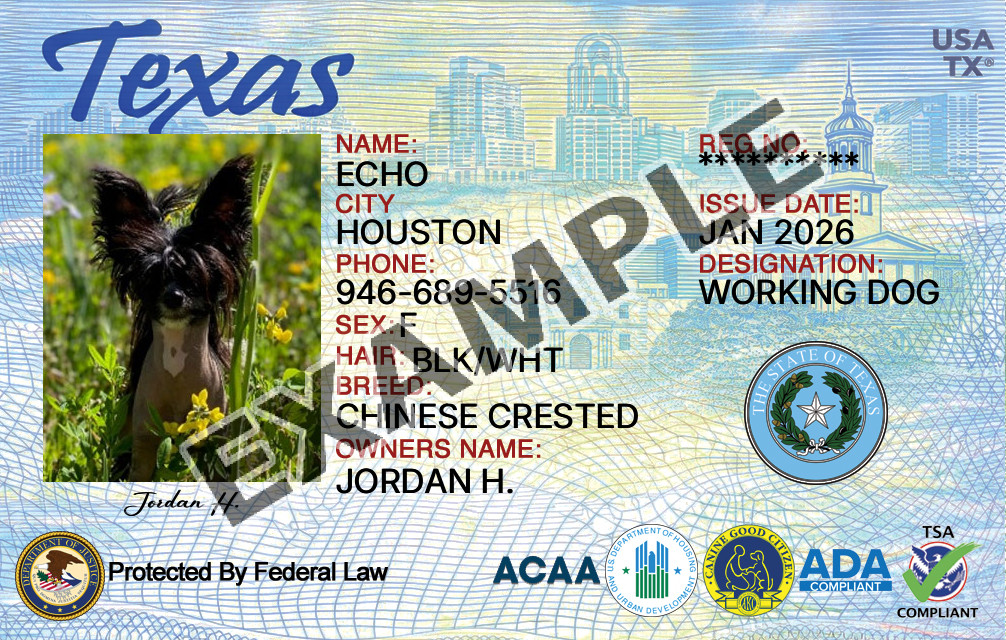
Many people are targeted by online “registration” offers. For service dogs, there is no universal government-issued service dog “license” card required for public access. Local licensing rules (if your city requires them) still apply the same way they would to other dogs—rabies vaccination is still a public health requirement.
Practical guidance for residents
If your dog is a service dog and you’re trying to figure out where to register a dog in Galveston County, Texas, handle it as two separate checklists: (1) comply with local animal licensing/rabies rules, and (2) understand your service dog access rights and responsibilities. If you have a city licensing program, ask whether any fee reductions exist for certain cases (policies vary by municipality).
Emotional Support Animal Rules in Galveston County, Texas
ESAs are not service dogs
An emotional support animal (ESA) provides comfort by its presence, but it is not the same as a service dog trained to perform specific tasks related to a disability. This matters because:
- ESAs typically do not have the same public access rights as service dogs in places like restaurants or stores.
- Local licensing and rabies requirements still apply to ESAs the same way they apply to other pet dogs.
What “ESA registration” usually means in practice
For local government purposes, there usually isn’t a special “ESA license.” If your city has a licensing/tag system, you follow that system. If animal control asks for proof of compliance, the key document is commonly the rabies vaccination certificate (and any required city tag).
If you rent housing in Galveston County
Housing rules can differ from public-access rules. If your landlord requests documentation for an assistance animal, that’s a housing process—not a county dog licensing process. Regardless, maintaining rabies vaccination proof and following local ordinances helps avoid conflicts and ensures you can demonstrate responsible ownership if questions arise.
